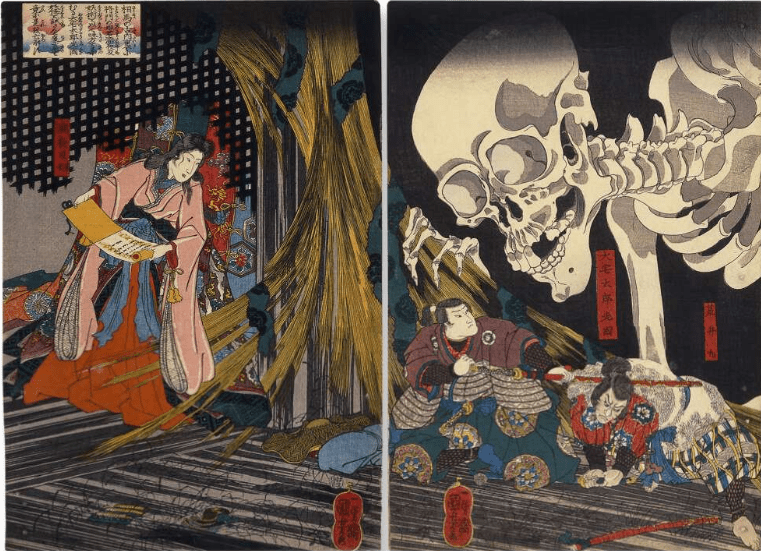
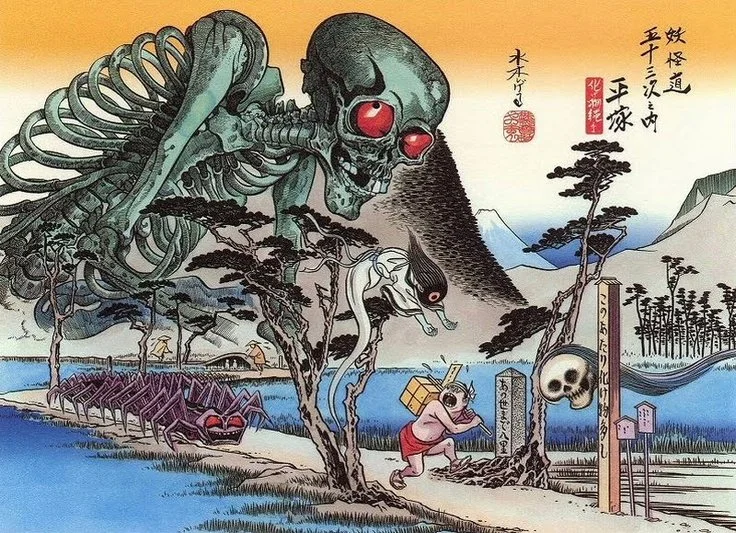
Japanese Yokai (demons if you will) are filled with the bizarre and horrifying. The Gashadokuro doesn’t top my personal list, but it has some rich features and backstory that are worth a look. To begin–this is a 90 foot skeleton that roams around at 2AM eating people, more or less. As a mythological creature, its story and features change over time, retelling, and region.
Origin (HEAVILY abridged): The first mention of this Yokai dates back to the tenth century. The tale that led up to the summoning of the Gashadokuro is a long, complicated one involving samurais, duals, honor, throne usurping, two full scale battles, and a series of revenge killings. To further complicate matters, many Japanese mythologies are tangled with historical accounts, making it difficult to pick out what lives in myth and what graces history. However, the star of our show is Takiyasha Hime, a powerful sorceress, and depending on which side of the battle you were rooting for, possible princess. After her father was killed, Princess Hime cast a spell to knit the bones of the fallen soldiers together to make the terrifying Gashadokuro. Yes, big daddy skeleton is made up of the warrior bones. She then unleashed the nightmare onto Kyoto.
While this is the first known mention, mythos have sprung up which depict the Gashadokuro rising up from the remains of villages wiped out by famine. These versions of the tale have given it the title “the starving skeleton”, as it insatiably seeks out human flesh when it roams the land in the dead of night.
Features: Some say the Gashadokuro can be heard by the rattling of its teeth–a sound called “gashi gashi” (not too unlike the English word gnashing). Others say you will hear a ringing in your ears when it approaches. Either way, you must keep your wits about you, because when the Gashadokura spots you, it can become silent and invisible for the sake of the hunt (although it is said certain charms can make it visible again). It will not stop until it has either devoured you or the spiritual fury knitting its bones together has died out. Exhausting it is the only documented way of defeating it.
Personal Thoughts: I truly wish I had a knack for animation and drawing. There are numerous depictions of the Gashadokura, but all of them simply depict a giant skeleton. The idea of bones from hundreds of famine ridden villagers or battle fallen soldiers–lacing together, unnatural joints connecting and twisting–to create the terrifying visage of the cumulative rage and pain experienced by those who weave its very being is mesmerizing. This feature of smaller bones making up the greater Gashadokura are missing from the depictions that exist of this blood crazed bone daddy. Speaking of missing things: Takiyasha Hime. Hundreds of men fought and died in their bout for power, wifey rights, and honor while a singular woman ended the entire affair with one terrifying blow. I have to do more digging on her, because if she was the period at the end of the long, bloody sentence that is this tale, I can only imagine her life outside of punctuating someone else’s story.
And lastly, if it’s a composite human skeleton eating human flesh, is it cannibalism? Or only if it eats the bones?

 Obi Yonder